Everyone's projections are the same. Wins aren't.
Every expert ranking you can buy is trying to predict points. Points are not what you win — you win one matchup a week, and the lineup that wins it is not always the lineup that projects highest. Gridiron Edge sets the lineup built for the win you actually need: floor when you are ahead, ceiling when you need the week to go strange.
Run the whole thing free right now — nothing to install. A full practice auction against simulated rivals, with the real advisor pricing every player, in the browser or on your phone. No credit card, any league size.
{{ draftLine }}
The weekly work runs all season and is the half a thin per-call edge needs volume to pay off. The draft half is the one you cannot go back for — which is why the refund window closes when you attach a live room rather than in September.
Watch it price a room before you trust it with yours
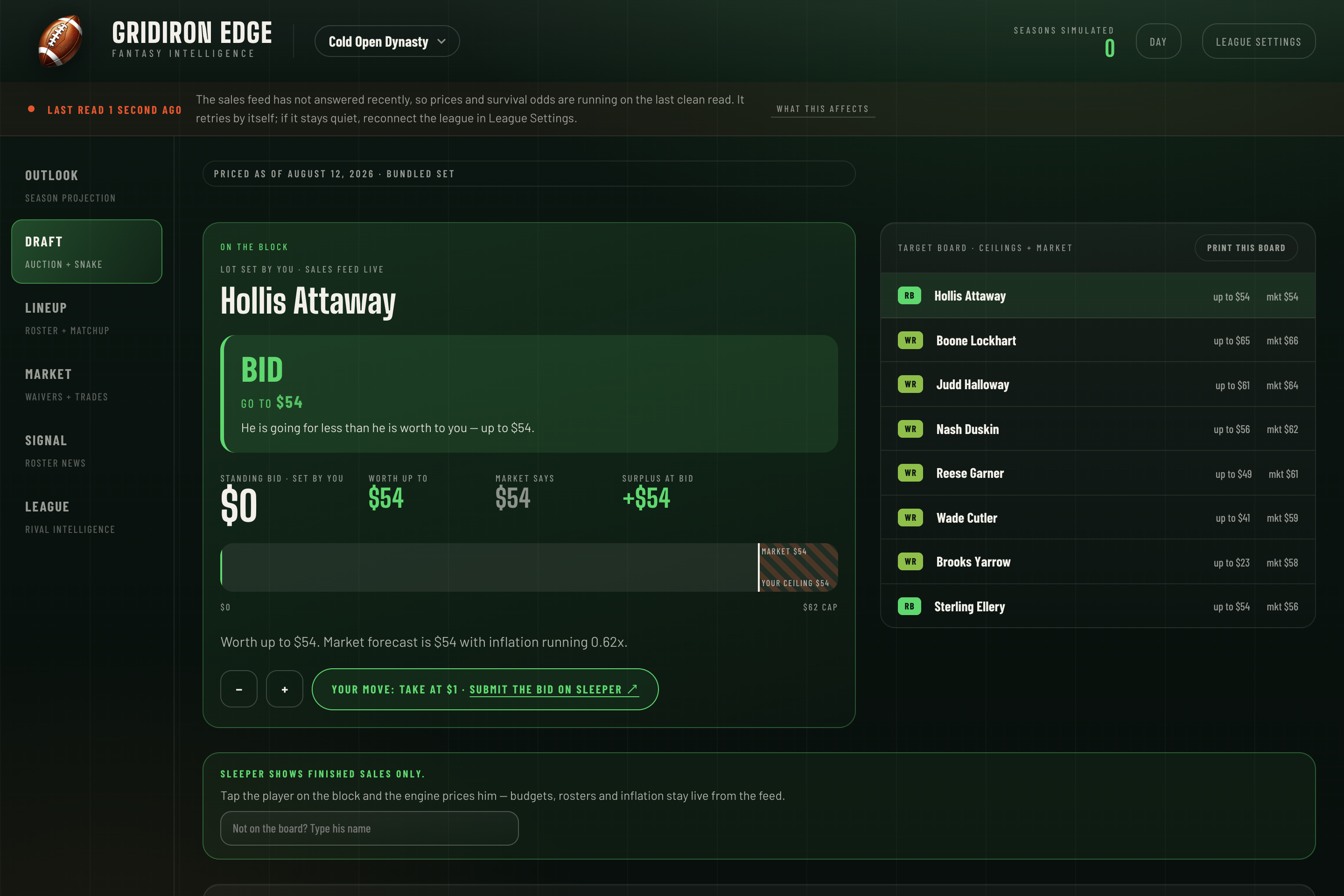
No narration and no edit tricks — the practice auction running against simulated rivals, budgets and inflation tracking every sale, and a walk-away price on the player in front of you. This is the screen you get free today, at any league size.
Recorded in the shipping build. The rivals are simulated and the dollar figures are demo fixtures — illustrative, and deliberately unrelated to any measured figure in the backtest.
Who do I take here, and what is he worth to my seat?
What is my walk-away price on this player, right now?
Which claim is worth the money, and how much?
Who starts, against the roster I actually play this week?
Four decisions. It does not predict better — it decides better.
Keepers price into the board with the costs they carry; a superflex seat values a second quarterback because the seat exists, not by a multiplier. It runs in a browser, phone included: Sleeper needs no extension at all, and on ESPN the in-season screens and public leagues do not either — a live ESPN draft room is the one job that still wants the Chrome extension on a desktop, because a web page cannot read another site's page. If your league is on Yahoo it will not read it at all, and this line is here so you find that out before you pay rather than after.
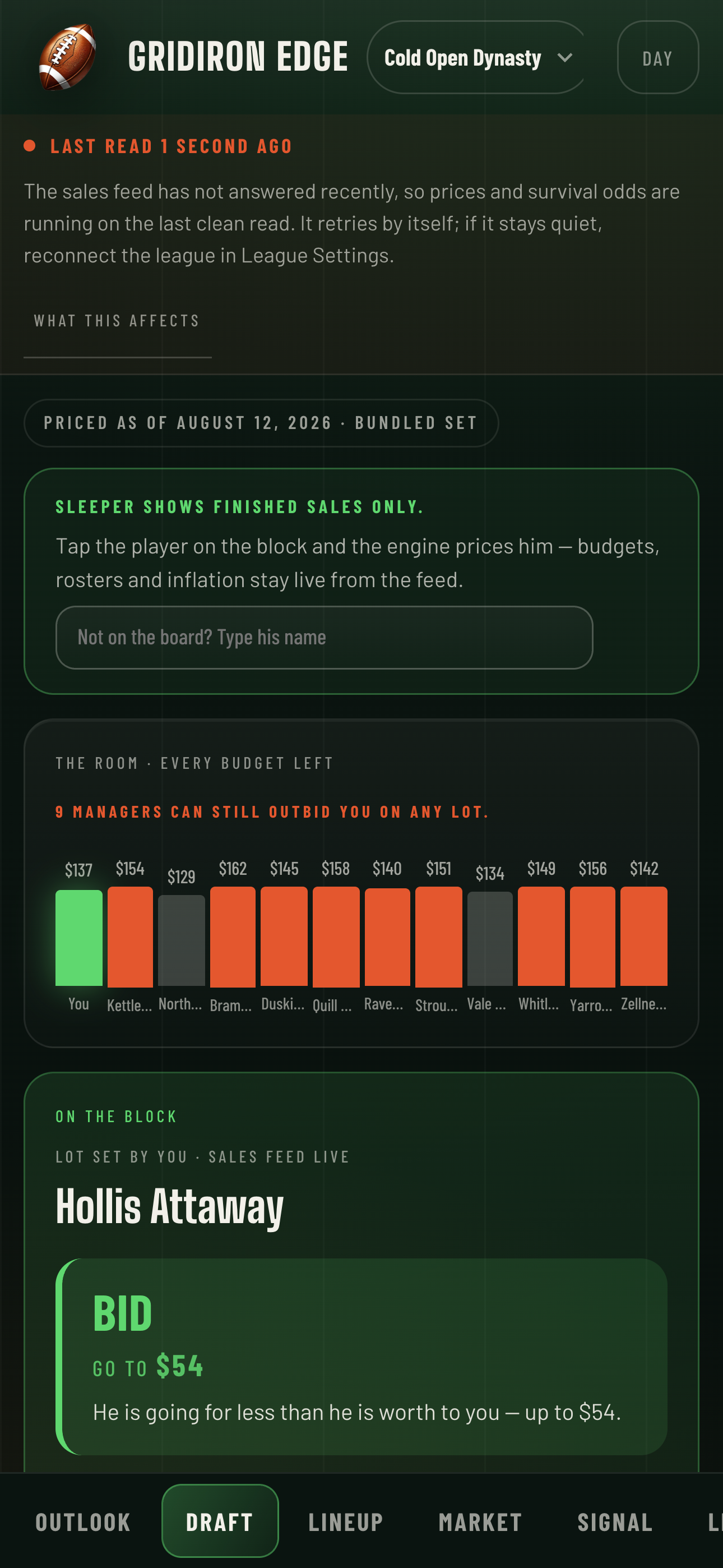
A live Sleeper auction, in a browser tab, with nothing installed
The nav moves to a bottom bar, so it behaves like an app you keep rather than a page squeezed onto glass — which matters because Tuesday waivers and the 12:45 flex call happen where you actually are. On Sleeper that is the whole product, phone included. On ESPN the in-season screens work the same way; only a live ESPN draft room still wants the desktop extension. Open it full screen and the strip at the top is the app telling you the sales feed went quiet, rather than pretending its prices are current. Demo league, illustrative figures.
Your league is optimising the wrong number
Every manager in your league starts the week with the same board and the same instruction: start your highest-projected players. That instruction maximises expected points. Nobody in fantasy football is paid in expected points.
Points are the mean. You are playing one opponent
The highest-projected lineup is the lineup with the highest average — the right answer if you played the whole league at once. You play one roster, once, and only the margin counts.
Against a heavy favourite the safe lineup loses politely; you need the outcomes where the week goes strange. Against a weaker roster the reverse holds and the boring lineup is correct. The projection sheet cannot tell those weeks apart because it never looks across the table.
Solve for the win you need, not the mean
Your roster is simulated as distributions rather than single numbers, and the lineup is solved twice: once for floor, once for ceiling. You choose the objective and the starters change under it. Most weeks the two answers agree, and it says so plainly rather than inventing a move.
Choosing that objective for you has shipped: each week the app reads who you actually play, simulates your floor lineup and your ceiling lineup against that opponent — ten thousand runs each — and makes the call with the trade-off in its own numbers, the way it renders them: “CEILING wins 34% vs FLOOR's 31% — you're the underdog.” Inside simulation noise it says the two are level rather than inventing a preference; when it cannot read your opponent it says so and drops to season-strength advice. What it does not carry is a season-long value for switching by matchup — that is unmeasured, so no number for it appears anywhere here.
A late scratch re-solves the whole week
Inactives land ninety minutes before kickoff, and they do not only change the player who is out — they change which of your remaining lineups wins, because the opponent's week just moved too.
The week is re-simulated on the new information and you get one instruction with the reason attached, or “no change” with the reason for that. Whatever it cannot read — a coach's snap-count plan, a beat writer's hunch — it names instead of pretending to price.
{{ proofCaption }} Method →
Floor or ceiling is the whole question
The live lineup screen, week 11, a real sixteen-man roster attached. Two lineups sit inside it: the one built for floor and the one built for ceiling. Tap either and the starters change — and note that the ceiling lineup projects fewer points than the floor one. That is the whole argument in one click: down twelve with three players left, the safer, higher-projecting lineup is the losing one. Live product, computed from the league shown; projections are modelled estimates rather than outcomes.
The outlook is a distribution, not a forecast: the same roster finishes in a range, and the width of that range is the point. What is on the lineup screen is the solve and its reasoning: every slot filled or named as empty, the projection behind each starter, and the objective it was solved for. The opponent is on it too: the schedule gives the app who you play, both lineups are simulated against that roster, and each carries its own win probability so the call arrives with its trade-off attached rather than as a verdict. Those probabilities are computed live, per matchup — what stays unmeasured is whether switching by matchup wins you more games across a season, so no season-long figure for it appears anywhere here. The measured weekly numbers, and their denominators, are in the backtest.
We built our own projections first. They lost.
Forty-one features tried, walk-forward, tested properly: 0.583 for the open model that ships against the expert consensus' 0.623. It lost, and that result is why this product competes on decisions rather than forecasts — if everyone's numbers tie, the season is decided by what you do with them. The draft engine is where decisions happen under a clock: the live auction screen below, one instruction with a walk-away price, computed for your seat in your room. ESPN auction rooms run fully automatic through the extension; Sleeper runs player by tap, because its API shows finished sales rather than the live bid — budgets, rosters and inflation still track themselves off the sales feed, and you point at the player on the block to get your ceiling for that player. Its old headline points-figure did not survive re-testing on the open data — the retirement is in the backtest, in full — so what this sells is the mechanism you can watch price a real player, not a number that would not reproduce.
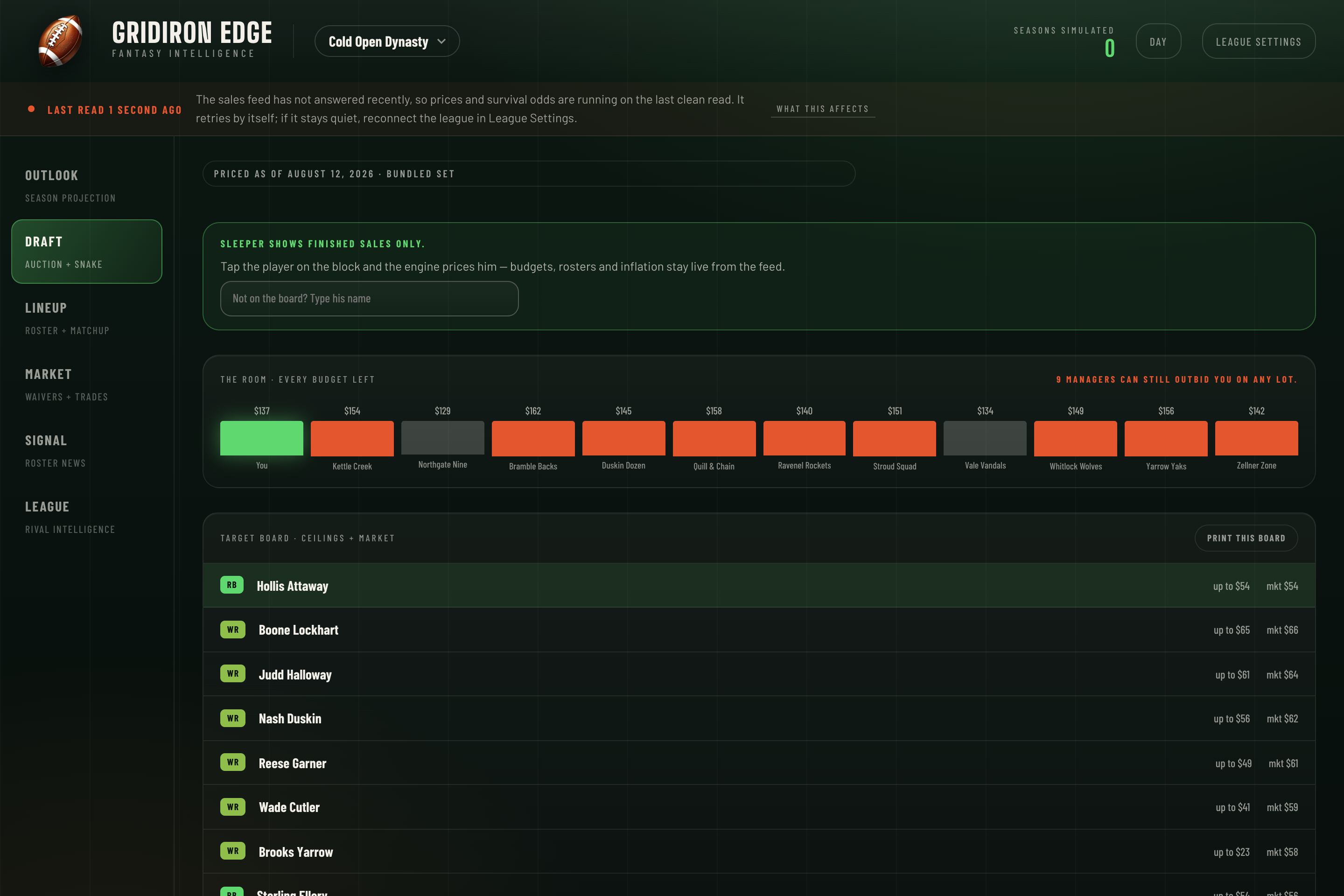
Under the call: what else this money could buy right now — the eight best players left, each with your ceiling and the market price. Live product; every figure is computed from the league shown, and projections are modelled estimates rather than outcomes.

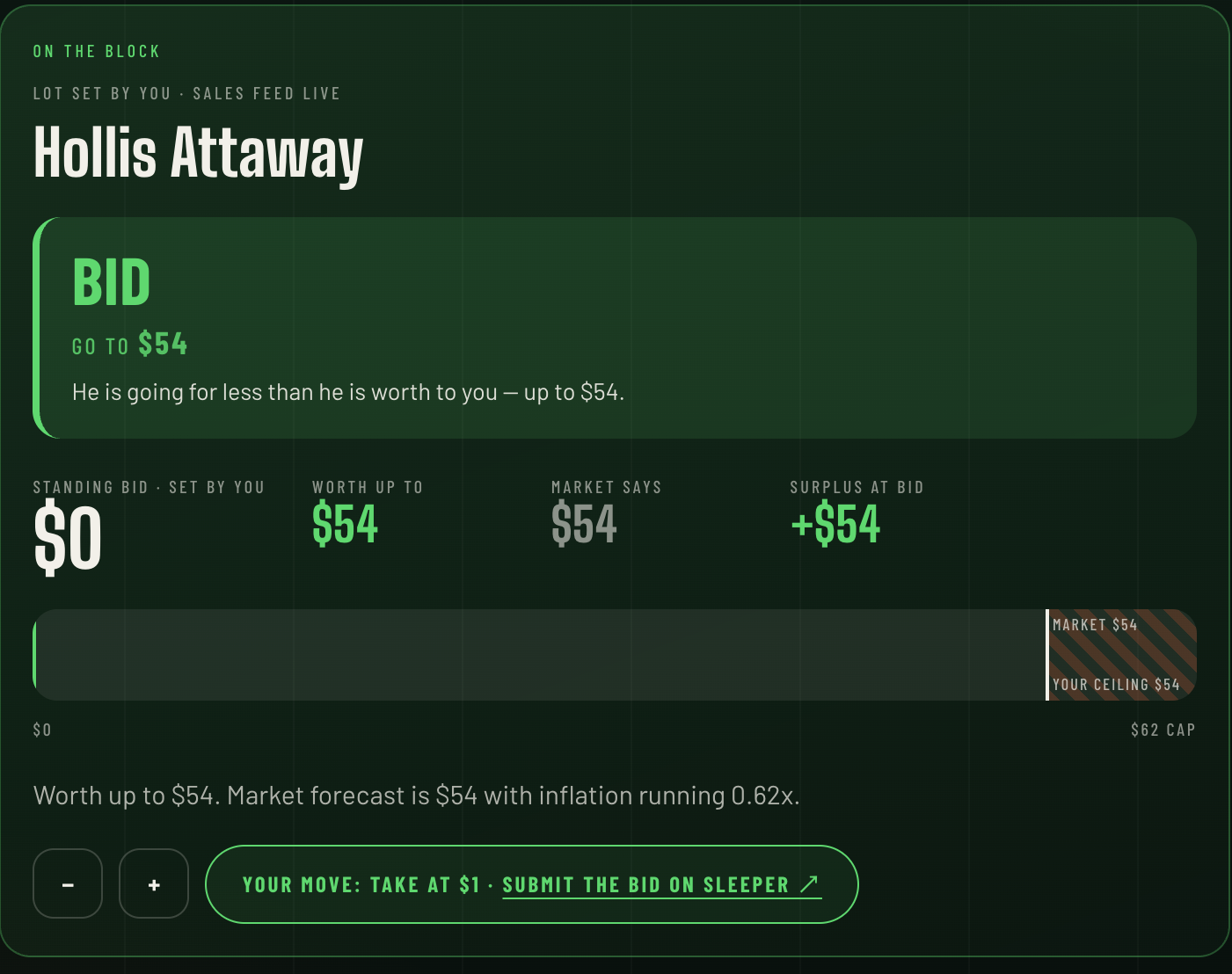
The ESPN panel above is the app rendering live on this page. The two Sleeper frames are screenshots of the shipping build in a real Sleeper auction — the league, the players and the dollar figures in them are demo fixtures, illustrative and deliberately unrelated to any measured figure in the backtest.
Every recommendation carries its arithmetic
A ceiling you cannot take apart is a number you have to trust. Open any call and the line under it is there: what the player is worth to your roster, what a lineup point costs in this room tonight, and what is being held back for the seats you still have to fill.
Change one thing — a rival's budget, a bench seat, your scoring format — and the line recomputes in front of you. When an input is missing, the ceiling is withheld rather than guessed.
Five managers can still outbid you on this player; the ceiling is what he is worth to you, not a prediction of the winning bid. Step the live bid on the screen above and it recomputes against it. The market forecast is $42 too, and that is the normal case rather than a fault — a player whose replacement is nearly as good should not go above market. You cannot win the season in the draft. You can lose it there, at $58 for a $42 seat, and this is the number that stops you.
Three tiers, and we will not blur them
Everything below appears elsewhere on this page with its full method attached. This is the same information in the order that matters while you are deciding whether to pay: what has been measured, what ships without a number, and what we withdrew.
One prepaid season, one league, at the first-season rate One prepaid season, one league, at the standard rate
Paid once, before your draft. A licence is per league: Season runs one league, and you add a league for $29 each on the same key. Seasons, not months — no auto-renew, no in-season upsell.
The whole product, draft through the final week. The weekly decisions are the part that runs for fourteen weeks and the part a thin per-call edge needs volume to pay off — which is why there is no draft-only tier.
Add a league, $29 each, on the same key — from Settings in the app
About $2.30 a week for the season, and your draft is in the first one.
ESPN and Sleeper · auction and snake · keepers · superflex and 2QB · one league per licence, add a league for $29. Yahoo it does not read, and it says so before you pay.
For managers running several leagues, where one player quietly becomes your whole season.
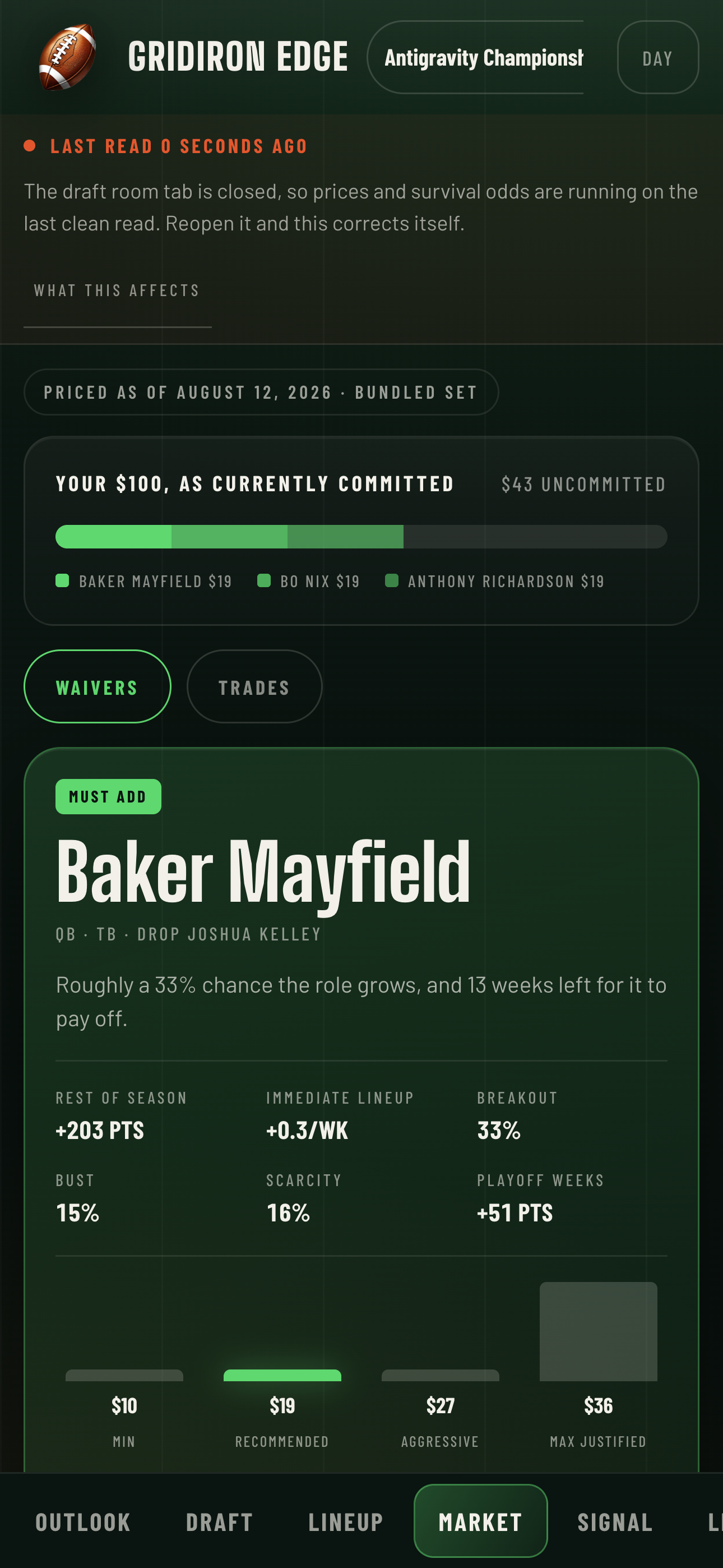
Tuesday morning, on a phone: one claim ranked with its odds and a bid ladder — minimum, recommended, aggressive, and the most it can justify. Bottom-bar nav, thumb reach, no install. Demo league, illustrative figures.
Everything is live now — draft and auction calls, the waiver policy, weekly lineup calls and the outlook. Pay and it is in your account immediately; there is nothing left to wait for and no launch date to come back for. What changes on 8 September is the price, not the product.
Whatever you pay today is your renewal rate for every season after this one — not an introductory rate that expires. Buy at $49 and you renew at $49 while new buyers pay $59 from 8 September; Multi-League holds the same way at $119, and an added league holds at $29. The ladder on this page is the price of waiting, and it compounds every year rather than costing you ten dollars once.
Full refund within fourteen days, or any time before you attach a live draft room — whichever comes first. No reason required and no form to argue with. The draft is the one call you cannot take back, so that is where the window closes; everything up to it is reversible, which is the point.
Before 8 September, buy the season — you are still ahead of the part that runs while the board moves. From 8 September there is an in-season licence at $29 for one league, which is the honest price for what is left of the season. It does not include the live draft room.
What this will not do for you
A tool that tells you when it does not know is the only kind you can act on with money at stake. So before the measurements, here is where ours stops — starting with the limit the whole product is built on top of.
It will not out-project the experts. Nothing does, including them
We tested that rather than assuming it: a walk-forward projection model, forty-one features tried, the shipping open model scoring 0.583 against the expert consensus' 0.623. It lost. Ranking players off public box-score history is a solved, crowded problem, and any claim to have beaten it from this data would be overfitting.
Which is exactly why the forecast is not what is for sale. Everyone in your league already has the same rankings; nobody has the decisions. Every insurer buys the same weather data — the edge is in the underwriting. The claim here is narrower and testable: given the numbers everybody already has, it sets the lineup that wins the matchup more often.
And “more often” is not “usually”, and it is not often. We ran five test seasons. Against a season-average board, the calls where we disagree are a coin flip — 51.0% across the five folds — so that claim is retired, out loud. Against the board most managers actually run, whoever produced the last three weeks, contested calls land right in every one of the five seasons — 56.0, 57.9, 63.0, 60.2 and 63.8 percent, averaging 60.2% — and the newest of them, 2025, is the strongest. A handful of thin calls is what $49 buys. If you are buying a week, do not buy this. See how it was measured →
It cannot reliably win you the title
A better draft reliably gets you into the tournament. It cannot reliably win it. A six-team bracket is three consecutive single-elimination games; being the best team in the field gets you to perhaps 60% per game, and 0.6³ ≈ 22%.
A title is a multi-year proposition
At 11.5% per season — nine-season re-measure, August 2026 — the chance of winning at least one title is roughly 46% over five years and 71% over ten. Any per-season figure near 80% would require information that does not exist on draft day.
The waiver edge needs a passive league
The wire numbers above are measured against a passive league. When all twelve teams run the same policy the edge does not shrink — it cancels by construction: titles still sum to one, so the average gain is exactly zero. Every seat still adds about +35 points a season running to stand still, and 60% of leagues crown a different champion. The wire is a lever against a passive league and a tax in a sharp one.
If your league is sharp, here is what is left
What survives a sharp room is the draft: the ceiling arithmetic prices your room's actual money — sharp or soft — and never depends on rivals being wrong. Its old points claim did not survive re-testing on open data, and the backtest says so in plain sight. The wire does not go to zero either; it goes to zero only when every team runs the same policy, and most "sharp" leagues have three or four managers who work the wire and eight who check in on Tuesday. Measured at exactly that mix: the working seats beat the frozen seats of their own league by +4 to +6 points of title probability, and the frozen seats measurably pay for it (−1.5 to −1.9).
Which is the honest shape of this product: it works best when your league does not have it. There is no referral discount and there will not be one — sending this to your league is the one action that provably costs you. And in a room where everybody already prices correctly, the prices are correct: the edge left is small and mostly on draft day. If that is your league, buy the season for the draft and treat the wire as insurance.
You have read the part written to talk you out of it. That is the whole pitch: a tool that tells you the size of its own edge is the only kind you can bet money on.
This season gets scored in public
Every backtest on this site is history. So the contested calls get published as they happen: what the app said, what the consensus said, what occurred, and the running record — updated weekly from the first scored week, on this site, for anyone to read whether or not they paid.
It will be published as a cumulative record with its noise band, never as a standalone weekly win-loss, because three to five calls a week is noise and a 1–4 week means nothing. The band is the honest part: early on it will be wide enough to include "no edge at all", and it will say so.
Tuned on 2018–20, frozen, then tested on 2021–25
Every competitor promises to win you your league. We publish the measurements instead — including the ones that went against us. Every comparison below is paired: same seasons, same players, same draft seats.
Note what is not claimed here: better predictions. We do not predict better than the expert rankings — nobody does. We decide better: which lineup beats the roster in front of you, what a seat is worth in this room, which claim is worth the wire. This is the paired backtest behind every number on this page, and every card below links to the run it came from.
One of twelve. The baseline every manager starts from — a fact of arithmetic, not a result.
Measured on a projection source we no longer ship; did not reproduce on the open data. The rung stays on the chart struck through, because deleting it quietly is how numbers stop being trustworthy.
A fair seat plus the waiver engine, against a passive league — nine-season re-measure: +67.5 points a season and a 63.7% playoff rate. The title rung lands at 11.5% against the fair seat’s 8.3%, with a season-level interval that touches zero. The points are the proof; the title is the lottery they buy tickets to.
Three separate experiments, each with its own runs, all from the same nine-season re-measure. The 8.3% baseline is arithmetic and was never part of the waiver comparison.
Measured on a projection source we no longer ship. Re-run on the open data that actually powers the product, drafting by our board is statistically indistinguishable from drafting by the market — so the figure is retired, in public, and the draft engine is sold on the mechanism you can watch work: a live ceiling for your seat, your money, your room. Find another fantasy site with this paragraph.
Every pairwise start/sit call in the 2024 test season — 3,902 player-weeks — scored against a board built from each player's last three weeks. Backtest measurement, out-of-sample 2024; a shorter window than the draft engine above, and the section says why.
Method →That is the denominator: 2.4% of the 133,388 pairs, the only ones where the two boards pick different starters. A hair above a coin flip, three to five times a season. Backtest measurement, out-of-sample 2024, and one test season cannot rule out a coin flip.
Method →Re-measured on the shipping engine, then stress-tested to nine seasons: +67.5 points per season (interval +34 to +101), and playoff odds of 63.7% against a passive league’s 50%. The title conversion is the noisy part — +3.1 points of title probability, and at nine season-clusters that interval touches zero — so the big figure here is the one that replicates, and the title number wears its caveat in the same breath. Five seasons had it at +7.0; nine seasons took it back, and the page moved with the data. That is the treatment every number here gets.
Start/sit calls where we disagree with the trailing-three-week board, scored on a season the model had never touched. Fifth straight fold above 50% — the four before it: 56.0, 57.9, 63.0, 60.2.
In a manager’s season that is small and specific: 2.4% of start/sit decisions are contested at all, so you are looking at a handful of weeks where this disagrees with you, and roughly two of every three of those going our way instead of one in two. Not a transformed season — a few coin-flips turned into better-than-coin-flips, which is all any honest edge here is.
Paired comparisons throughout, confidence intervals on every effect, and the runs where the edge disappears reported next to the runs where it holds.
Three ways in. One of them fits your league
This is the real attach screen, not a diagram. It reads ESPN and Sleeper leagues — Yahoo it does not, and I am not promising it.
Open app.gridironedge.app — nothing to install. On Sleeper, paste the league id and you are done, because its API is public. On ESPN, paste a public league id, or run the bookmarklet once on your league page so it reads with your own session, which is how private leagues work without handing over a password. Two or three minutes, at your kitchen table rather than 7pm on draft night. The Chrome extension is the one thing you add for a live ESPN draft room, and only for that.
Open app.gridironedge.app on your phone, then Share → Add to Home Screen. Paste a Sleeper league id and you are done in about thirty seconds — imports, live snake drafts, player-by-tap auctions and every in-season screen, with nothing installed. On ESPN the in-season screens work the same way; a live ESPN draft room is the one thing that still wants the extension on a desktop, so plan draft night there.
You do not need a room to rehearse in one. The app runs a full practice auction against simulated rivals driven by the same market model that prices real drafts, with live ceilings from the real advisor — any league size, $100 or $200, eight to fourteen teams, or one click to match your own league's exact shape.
Blow your budget on the wrong player and run it back: same seed, same room, same rivals. Free, no credit card, any league size — which makes it the honest way to find out whether the ceiling arithmetic is worth $49 to you.
Run a practice auction — freeQuestions
What do I have to connect?
An ESPN or Sleeper league, and in most cases nothing more than its id. Sleeper needs no extension anywhere — its API is public, so a browser tab or your phone is enough. ESPN works the same way for public leagues and for every in-season screen; a private league wants the bookmarklet once, and a live ESPN draft room is the one job that still needs the Chrome extension on a desktop, because a web page is not allowed to read another site's page. That is a browser security boundary rather than something on a roadmap. Either way the app tells you how much of the board it managed to read.
I'm on Sleeper, or Yahoo. Can I use it?
Sleeper, yes — and on Sleeper there is nothing to install at all, phone included. Open app.gridironedge.app, paste your league id, and you have the whole product: the import, live snake drafts, player-by-tap auctions and every in-season screen, in a browser tab or added to your home screen. Thirty seconds, no extension, no permissions to grant. Auctions work slightly differently there, and the difference is worth knowing. Sleeper's API shows finished sales rather than the live bid, so the app keeps every budget, roster and inflation figure current automatically off the sales feed, and you tap the player on the block — or type three letters — to get your ceiling for that player. One tap per contested player; everything else runs itself. ESPN auction rooms are fully automatic through the extension. Yahoo is still no, and I am not putting a date on it.
You are one person. What if you stop?
Fair question, and the structure already answers most of it. It is a season, not a subscription: nothing renews, so there is nothing to cancel and no credit card sitting on file to be forgotten. Everything is already live, so there is no launch left to miss; and if you change your mind, the refund is fourteen days wide, or until you attach a live draft room. The backtest is published rather than promised, so the evidence you bought on outlives me either way, and every board prints. What I will not do is pretend one person is a company: there is no support SLA here, mail lands on my desk, and the honest answer to “what if you get bored in October” is that the money for a season you did not get is not mine to keep.
Keepers? Superflex?
Both. Enter your keepers with the costs they carry and the board, the budgets and the inflation curve all price around them rather than pretending the money is still on the table. Superflex and 2QB use real slot eligibility on both platforms: a second quarterback is worth what the extra seat makes him worth, not a projection multiplied by a fudge factor.
My draft is next week. Is that enough time?
Yes.
Can I try it before I pay?
You agree with a free rankings board 97.6% of the time. Why would I pay?
Because almost nobody plays off a season-average board. Most managers start whoever produced the last three weeks, and against that board the contested calls land right 60.2% of the time across five straight out-of-sample seasons. And the start/sit call is the smallest of the three things you are buying: the wire adds points in every season we can measure — nine for nine — and playoff odds with them; the title bounce is real but noisy, and this page says exactly how noisy, the draft is the one you cannot go back for, and the coin-flip result against season-average boards is published because leaving it out would be choosing the flattering numbers.
Why publish the parts where it loses?
Because the alternative is asking you to take a promise on faith with money down.
Is it affiliated with any league or platform?
No. It is an independent tool, unaffiliated with and unendorsed by any professional league, players' association or fantasy platform. See the notice below.